How to Support Nerve Health Naturally: A Calm, Everyday Guide
| The idea | Your nerves are living tissue — support them with the right nutrients, calming botanicals and steady daily habits. |
| Key nutrients | Magnesium and B-vitamins for nerve signalling; antioxidants like turmeric and alpha-lipoic acid for protection. |
| Everyday calm | Ashwagandha and L-theanine are traditionally used to support calm and stress resilience. |
| Consistency | Support works best with daily, consistent use over several weeks. |
Why nerve health deserves more attention
Your nervous system is the body’s messaging network — billions of nerve cells carrying signals between your brain and the rest of you, every second of every day. When that network is well nourished and calm, life feels steady. When it’s under-supplied and over-stimulated, the effects show up in small but frustrating ways: restless evenings, a mind that won’t switch off, hands that feel a little less steady, and a sense of being “wired but tired.” Calderon-Ospina and Nava-Mesa set out how the nerve B-vitamins act together in CNS Neuroscience & Therapeutics (2020).
Most people never think about their nerves until something feels off. Yet nerve tissue, like the rest of the body, depends on a steady supply of specific nutrients and benefits enormously from lower everyday stress. The good news is that supporting healthy nerves naturally is largely about consistency — a handful of nutrients, a few calming botanicals and some sustainable daily habits.
First: which nerve symptoms need a doctor, not a supplement
Natural nerve support is for people who are broadly well and want steadier, calmer days — it is not an answer to a nerve that has started misbehaving. Numbness, tingling, burning or weakness is a symptom with a cause, and the cause has to be found before anything is added to a routine.
Book an appointment rather than reaching for a bottle if the sensation is new, if it is getting worse or spreading, if it is one-sided — one hand, one foot, one side of the face — or if there is real weakness: a foot that drags, a grip that fails, trouble with buttons or stairs. The same applies if you have diabetes or prediabetes, drink heavily, have had bariatric surgery, take metformin long-term or follow a strict vegan diet without a B12 source.
Those symptoms have causes a supplement cannot touch and a clinician can test for: raised blood glucose, a compressed or trapped nerve, an underactive thyroid, alcohol-related nerve damage and vitamin B12 deficiency among them. A blood test and an examination are the correct first step, and taking a nerve-support supplement instead of getting that check can delay a diagnosis that matters. Nothing on this page is a treatment, cure or prevention for neuropathy or any other nerve condition.
The nutrients your nerves rely on
A short list of nutrients does the heavy lifting when it comes to everyday nerve support. These are the ones worth knowing about, with the reference intakes taken from the NIH fact sheets on magnesium and vitamin B12.
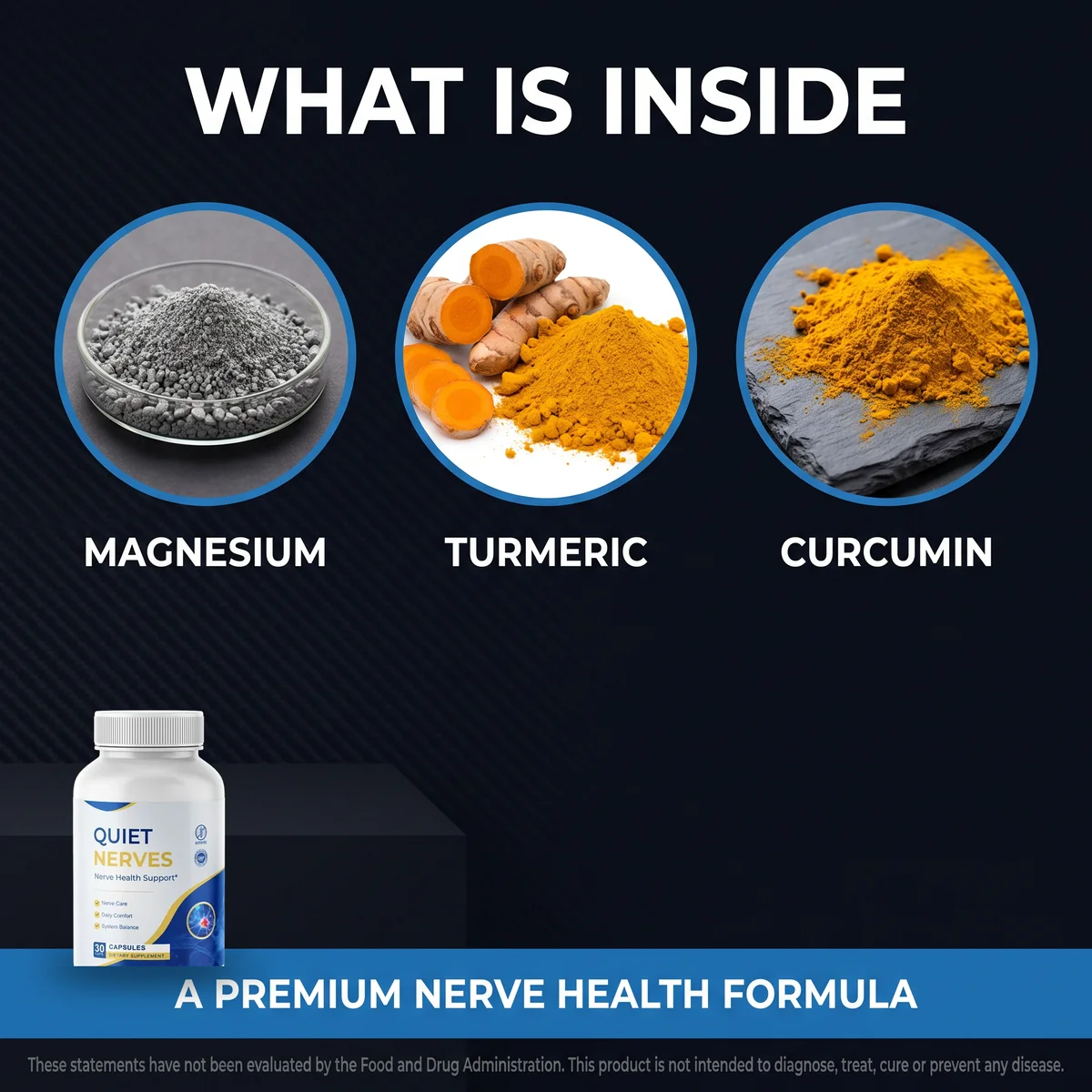
Magnesium. Often called the “relaxation mineral,” magnesium is involved in hundreds of processes in the body, including healthy nerve signalling and muscle relaxation. Modern diets — heavy on processed foods and light on leafy greens, nuts and seeds — leave many people falling short, which is why it’s a cornerstone of most nerve-support routines. The form on the label decides how much of it you actually absorb, which is why we compare them in the guide to the best form of magnesium for nerve health.
B-vitamins. Vitamins B1 (thiamine), B6 and B12 are the classic “nerve vitamins.” They help nerve cells produce energy and support the myelin sheath, the protective coating that lets nerves send signals cleanly. B12 in particular becomes harder to absorb with age, so it’s a common gap for older adults. Nerve-specific formulas often swap plain thiamine for its fat-soluble cousin, a choice we unpack in benfotiamine vs thiamine for nerve health.
Antioxidants. Nerves are sensitive to oxidative stress — the everyday cellular “wear and tear” that antioxidants help neutralise. Alpha-lipoic acid is a standout here because it works in both watery and fatty parts of cells, and the curcumin compounds in turmeric are widely studied for supporting a healthy inflammatory response around nerve tissue. Vitamin D belongs in the same conversation because it behaves more like a hormone than a vitamin and low levels are common in winter — see vitamin D and nerve health.
See what is in Quiet Nerves
A once-daily capsule with six named ingredients and 60 days to decide whether it suits you.
See Quiet Nerves PackagesCalming botanicals for everyday stress
Nutrients keep the hardware running, but calm is just as important. Chronic, low-grade stress keeps the nervous system in a state of mild alarm, and over time that takes a toll on how steady and rested you feel. Two natural ingredients come up again and again for everyday calm. The National Center for Complementary and Integrative Health keeps a plain summary of the evidence and the cautions on its ashwagandha page, and Hidese and colleagues tested L-theanine in a randomised controlled trial.
Ashwagandha is an adaptogenic herb used in traditional wellness practices for centuries. Adaptogens are so named because they’re used to help the body “adapt” to stress and stay in balance. L-theanine, an amino acid found naturally in tea leaves, is prized for promoting a sense of relaxed focus — calm without drowsiness — which is why it pairs so well with a busy day. Neither is the same thing as swallowing the calming neurotransmitter itself, a shortcut whose limits we explain in GABA supplements for calm.
It’s worth being clear-eyed here: these ingredients are everyday support, not medicine. They’re best thought of as a way to nudge your baseline toward calm, not a fix for a medical condition.
Daily habits that protect your nerves
Supplements work best alongside the basics. A few habits do more for your nerves than any single pill:
Prioritise sleep. Deep sleep is when the nervous system resets. Keeping a consistent bedtime and winding down without screens gives your nerves the recovery time they need.
Move most days. Gentle, regular movement — walking, stretching, light strength work — improves circulation and is one of the most reliable natural stress relievers there is.
Eat for your nerves. Leafy greens, nuts, seeds, eggs, fish and colourful vegetables supply magnesium, B-vitamins and antioxidants in their most natural forms. A supplement helps cover the gaps, but food comes first.
Manage the stress you can. Slow breathing, a few minutes outdoors, and simply saying no to a little more than you used to all lower the everyday load on your nervous system.
How long natural nerve support actually takes
Nutrient-based nerve support works on the timescale of tissue, not on the timescale of a painkiller. Nothing here switches on in an hour.
Magnesium status responds fastest, because it is a matter of topping up a circulating mineral: people who were genuinely short often notice easier evenings and fewer night-time cramps inside a fortnight. B12 is slower, because the body has to rebuild stores that may have been running down for years, and any repair to the myelin sheath is measured in months rather than weeks. Antioxidant support such as alpha-lipoic acid or curcumin is slower still and rarely produces a moment you can point to — it is background maintenance, and its value is cumulative.
That timescale has a practical consequence: judge a routine over eight to twelve weeks of genuinely consistent use, not over a fortnight of remembering it most days. It also means the cheapest improvement available to most people is not another capsule but closing the gap between what the label says and what actually gets taken.
What to be sceptical about
The nerve-supplement aisle carries a handful of claims that do not survive contact with the evidence, and knowing them saves money.
“Repairs nerve damage.” No dietary supplement is proven to repair damaged nerves in humans. Nutrients can remove a shortfall that was limiting nerve function; that is a different claim, and an honest label makes it.
“Proprietary blend.” A blend that lists ingredients without individual amounts hides how much of each you are getting, and the expensive actives are usually the ones present in trace quantities. A panel with named forms and stated amounts is worth more than a longer ingredient list.
“More is better.” Vitamin B6 is the clearest counter-example in this whole category: sustained high doses can themselves cause sensory nerve damage, which is why an upper limit exists. Magnesium has a supplemental ceiling too. With nerve nutrients, the right amount taken daily beats a big number taken occasionally.
Putting it all together
Supporting nerve health naturally isn’t about a single miracle ingredient — it’s about giving your nervous system what it needs, consistently. Cover the key nutrients (magnesium, B-vitamins and antioxidants), lean on calming botanicals when everyday stress runs high, and protect the whole system with sleep, movement and a nerve-friendly diet.
Quiet Nerves is a single daily capsule that names magnesium glycinate, alpha lipoic acid, butcher’s broom, L-carnitine, turmeric and coenzyme Q10, so it covers some of the nutrients above and not others; its ingredient section lists them. Whatever path you choose, consistency is what turns good intentions into steadier, calmer days.
FAQ
Which nutrients matter most for nerve health?
Magnesium and the B-vitamins (especially B1, B6 and B12) are the classic nerve nutrients, supporting healthy nerve signalling and the protective coating around nerves. Antioxidants such as alpha-lipoic acid and the curcumin in turmeric are also widely studied for helping protect nerve tissue from everyday oxidative stress.
Can natural ingredients really help you feel calmer?
Calming botanicals like ashwagandha and the amino acid L-theanine have a long traditional and research history of being used to support a sense of calm and help the body handle everyday stress. They are best thought of as everyday support, not a treatment for any medical condition.
How long does it take to notice a difference?
Nutrients and botanicals for nerve support tend to work gradually and best with consistent daily use. Many people give a routine several weeks of steady use before judging how it fits their life. Individual results vary.
References
- Magnesium: Fact Sheet for Health Professionals (NIH Office of Dietary Supplements)
- Vitamin B12: Fact Sheet for Health Professionals (NIH Office of Dietary Supplements)
- Ashwagandha (National Center for Complementary and Integrative Health)
- B Vitamins in the nervous system: Current knowledge of the biochemical modes of action and synergies of thiamine, pyridoxine, and cobalamin (CNS Neurosci Ther, 2020)
- Effects of L-Theanine Administration on Stress-Related Symptoms and Cognitive Functions in Healthy Adults: A Randomized Controlled Trial (Nutrients, 2019)
† These statements have not been evaluated by the FDA. This product is not intended to diagnose, treat, cure or prevent any disease. This article is for general information only and is not medical advice.